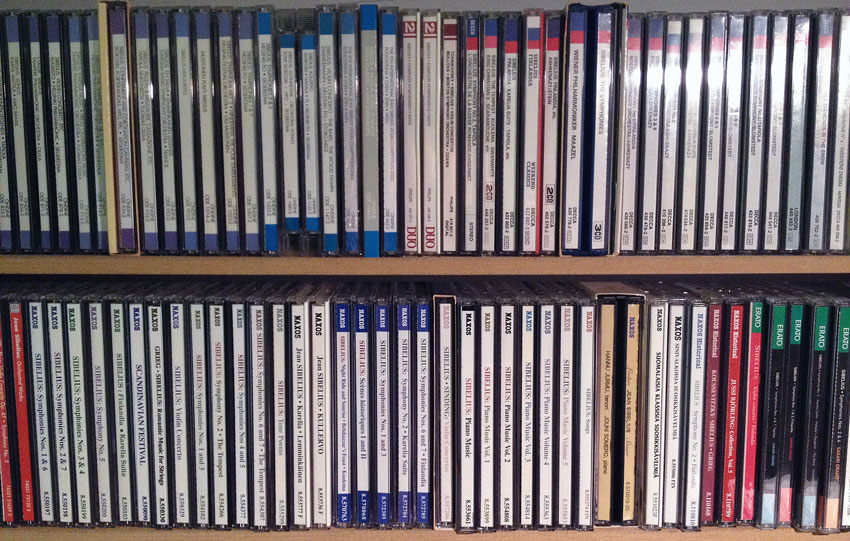
The ongoing Sibelius discography project has been updated.
To download the latest version click here: Sibelius_Discography_20160421.
For more information on the discography project and recent releases see our Discography & Recordings page.
Category Archives: News
Farewell to the V-Sibelius
Music by Sibelius’s teacher
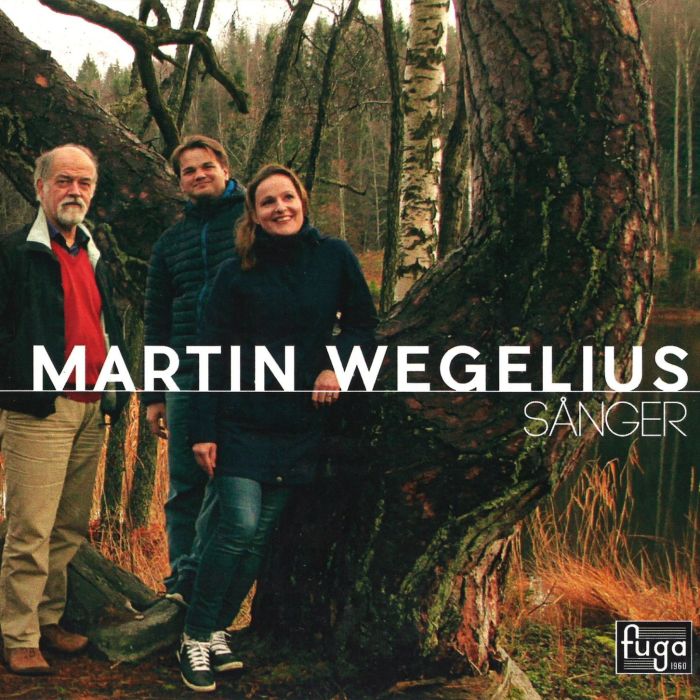
A disc of songs and folk song arrangements by Martin Wegelius has been published by Fuga (FUGA-9410).
Wegelius – who founded the Helsinki Music Institute (forerunner of today’s Sibelius Academy) in 1882, was Sibelius’s teacher there from 1885 until 1889. Wegelius was a versatile musician – a pianist, composer, conductor and critic – who had studied in Vienna, Leipzig and Munich and who would direct the Music Institute until his death. He was to prove a good friend to Sibelius and take a kindly, even paternal interest in his development. Wegelius was a capable administrator who could take the credit for many international musicians (including Busoni) coming to Helsinki. He was also an obsessive Wagnerian, with a particular fondness for Die Meistersinger; he wrote a 323-page biography of Wagner and also established the first Finnish Wagner Society. His music has hitherto been very sparsely represented on disc.
The new recording features two of Finland’s foremost young singers, the soprano Hedwig Paulig and the baritone Tuomas Lehtinen, accompanied on the piano by Gustav Djupsjöbacka. Some of the items also feature a choral part, here performed by the Spira Ensemble.
Interview with Jukka-Pekka Saraste

As part of our occasional series ‘Me and my Sibelius’, an interview with the conductor Jukka-Pekka Saraste, made by Sibelius One in Cologne in December 2015, is now available.
Click here for the interview.
Sibelius discography: help wanted
A Sibelius discography is being compiled that will be made available via this website.
In the interests of making this discography as complete as possible, all Sibelius enthusiasts and Sibelius One members are invited to send in details of recordings in their collection and we shall add the information to what is already on file here.
At present work is in a preliminary stage. As soon as possible we shall make available a file listing those recordings already included, and alternative methods of submitting information.
In the meantime, if you would like to send details of your discs already, we would ask for as much as possible of the following information to be included:
- Work title and opus/JS/HUL number
- If only part of a work is performed, please specify which part(s)
- Soloist(s)
- Ensemble/orchestra
- Chorus
- Conductor
- Recording date
- Live recording?
- Release date
- Record label and catalogue number
- Format (e.g. LP, CD, mono/stereo)
- Country of release
- Any other relevant information
Please send the information to Ian Maxwell (click here).
Thank you very much for your help!
Would Sibelius Lie to You (Quiz)
Sibelius Medal awarded to Pekka Helasvuo

The Sibelius Medal of the Sibelius Society of Finland has been awarded to Pekka Helasvuo.
The medal was presented by Lauri Tarasti, outgoing president of the Sibelius Society of Finland, at a reception in Hämeenlinna Town Hall on Saturday 5th December 2015 as part of the Sixth International Jean Sibelius Conference.
Pekka Helasvuo, Licentiate of Music, has worked as a violinist in the Helsinki Philharmonic Orchestra, conductor and principal lecturer of orchestral and chamber music studies at the Helsinki Metropolia University of Applied Sciences. His subject of licentiate work was the Orchestration of the Songs by Jean Sibelius (Sibelius-Academy, Helsinki 2007). Helasvuo is currently working as an editor of the string orchestra works (Series III) for the critical edition of Jean Sibelius works (JSW).
This was the last presentation of the Sibelius Medal in its current form. A new design of medal will be used from 2016 onwards.
Christel Lee wins Sibelius Violin Competition

Christel Lee has won the 11th International Jean Sibelius Violin Competition in Helsinki. The prize winners are:
1st prize €25 000 Christel Lee, USA
2nd prize €18 000 Emmanuel Tjeknavorian, Austria
3rd prize €12 000 Friederike Starkloff, Germany
Three other finalists, Mayumi Kanagawa (USA), Minami Yoshida (Japan) and Nancy Zhou (USA), received a prize of € 2000 each.
The Foundation of Helsinki Conservatory of Music awarded a special prize of €3000 to Emmanuel Tjeknavorian for the best interpretation of Sibelius Violin Concerto
The City of Järvenpää awarded a special prize of €2000 to Friederike Starkloff for the best interpretation of a commissioned piece in second round. The commissioned piece was one of the award-winning pieces from the Jean Sibelius Composition Competition 2015.
The best Finnish contestant Pekko Pulakka received the special prize from Yleisradio: an invitation to make a recording for Yle.
Christel Lee will perform at the following concerts in December:
- with the Finnish Radio Symphony Orchestra, conductor Hannu Lintu, at the Jean Sibelius 150th Anniversary Concert in Hämeenlinna on 8th December.
- with the Helsinki Philharmonic Orchestra, conductor John Storgårds, on 10th December in Birmingham and 12th December in Dublin.
Source: www.sibeliuscompetition.fi
Sixth International Sibelius Conference, Hämeenlinna 2015
The Sixth International Jean Sibelius Conference will take place in at Verkatehdas in Hämeenlinna, Finland, from 4th to 8th December 2015.
The conference will gather eminent scholars from all over the world with a wide variety of presentations on many different aspects of Sibelius’s life and music.
The presentations, which will take place in two parallel sessions throughout, will be as follows:
- James Hepokoski: Early Sibelius, Primitivist-Modernism, ‘News of War’
- Les Black: Dorian Departure
- Aare Tool: Jean Sibelius and the Modes of Limited Transposition
- Benedict Taylor: Monotonality and Scalar Modulation in Sibelius’s Tapiola
- Philip Ross Bullock: Sibelius Reception in Britain, 1901–1939: Centre Periphery in the Musical Construction of the North
- Laura Gray: The Tipping Point and the Rise of the Sibelius Cult in England
- Helena Tyrväinen: Sibelius and the French Press in the 1920s: Initiatives, Mediators and Interpretations
- Edward Clark: Sibelius and contemporary composers
- Martti Laitinen: Why Kajanus went to St Petersburg
- Vesa Kurkela and Olli Heikkinen: Sibelius as popular composer: Music by Sibelius in Kajanus’s popular concerts
- Vesa Sirén: (topic to be determined)
- Kaarina Kilpiö: Soundtrack for ‘The New Military Branch’. Jean Sibelius’s music in Finnish propaganda films during World War II
- Charris Efthimiou: On the instrumentation of bass and melody line in Jean Sibelius’s early symphonic poems (1892–1894)
- Pekka Helasvuo: The formation of the mode of expression of dynamic and articulation markings in the notation of Jean Sibelius
- Juhani Alesaro: Analyzing Sibelius’s Satz
- Barry Wiener: Dahlhaus’s Paradigm and Sibelius Reception
- Ferruccio Tammaro: War-Symphonies and Peace-Symphonies: Sibelius’s Fifth
- Antonin Servière: Reflecting Sibelius’s Legacy in Today’s Composer’s Mind
- Nors S. Josephson: Sibelius at the Crossroads: Old Paths Leading To New Creative Departures in His Second Symphony (1901–1902)
- Sakari Ylivuori: From a Bon vivant to a War Hero – The Narrative Structure of Sandels (Op. 28)
- Lauri Suurpää: Unconfirmed Pastoral and Denial of Threat in the Slow Movement of Sibelius’s First Symphony
- Olli Väisälä: Sibelius’s Revision of the First Movement of the Violin Concerto: Strengthening Tonal Structure while Removing Tonal Clichés
- Kimmo Sarje: Sibelius and the Modern
- Ron Weidberg: Sibelius and Schoenberg
- Daniel Grimley: ‘I sing another song’: Sibelius, Hofmannsthal and the Subjectivities
of Jedermann - Ilkka Oramo: Sibelius’s Eighth Symphony – fact and fiction
- Marc Vignal: Sibelius and Mahler
- Jorma Daniel Lünenbürger: Jean Sibelius and the Cello
- Tuija Wicklund: Sibelius and Böcklin
- Anna Pulkkis: Sibelius’s Loulou Andantino – a Souvenir Composition with a Mystery
- Timo Virtanen: Sibelius’s Sketches for the Violin Concerto
- Gustav Djupsjöbacka: There are several ways of putting it
- Carola Finkel: The metamorphoses of Svartsjukans nätter
- Sanna Iitti: The Representation of Emotions in the songs Våren flyktar hastigt and Svarta rosor
- Leah Broad: Forests, Fires, and Factories: Sibelius and the Mechanical
- Eero Tarasti: How Sibelius Became Sibelius – Observations and Notes on the Emergence of His Style
- Tim Howell: Jean Sibelius: Progressive or Modernist?
- Tim Jackson: ‘The Company You Keep’: Recipients of the Honorary Doctorates from the 1936 Heidelberg Celebration – Sibelius and Those Honoured Alongside Him
- Mart Humal: Sibelius’s Incidental Music for The Tempest: Ariel’s Five Songs as a Cycle
- Veijo Murtomäki: Did Sibelius mean (some of) his miniature opuses to be taken as suites?
- Andrew Barnett: The BIS Sibelius Edition
- Benjamin T. Hilger: Sibelius’s Second Symphony Recordings – Tendencies of conducting within history
Among numerous live music performances that will take place during the conference is a concert by the Finnish Radio Symphony Orchestra conducted by Hannu Lintu, featuring the winner of the Eleventh International Jean Sibelius Violin Competition. The works to be performed are Tapiola, the Violin Concerto and Symphony No. 2. To check ticket availability for the concert: click here.
On the organizing committee of the conference are Erkki Korhonen (chairman), Andrew Barnett, Anna Krohn, Veijo Murtomäki, Eero Tarasti and Timo Virtanen.
Violin Concerto: Original Version performance material released
The Berlin-based publisher Robert Heinrich Lienau concluded a publishing contract agreement with Jean Sibelius in 1905. The first work included in the agreement was the Violin Concerto in D minor, Op. 47. After being criticized at its first performance on 8th February 1904, the concerto was withdrawn for revision. Out of respect for the composer’s intentions, the early version from 1904 could previously only be made public on rare occasions.
In keeping with the work carried out on the Jean Sibelius Complete Works Edition, and in order to meet the great interest of professionals in the 1904 version, the composer’s heirs and publisher have now decided to release it. This is a significant step not only for academia but also for performers and the public.
The early version of the violin concerto is generally regarded as more dramatic, virtuosic and Beethovenian than the revised version, as well as being harsher and more jagged. It exerts a peculiar charm and, together with the revised version of 1905, provides a unique insight into the workings of the composer.
Performance materials for the original 1904 version are available from:
Robert Lienau Musikverlag,
Am Dornbusch 24–26,
D-64390 Erzhausen, Germany.
Tel.: +49 (0) 6150 – 86775 – 0
website: musikverlag-lienau.de
e-mail: hire@musikverlag-lienau.de
Source: Robert Lienau Musikverlag Press Release