Jean Sibelius: Symphony No. 5 (1915 version)
Edited by Timo Virtanen
Breitkopf & Härtel JSW Vol. I/6a / SON 641 · EAN: 9790004803967 · Price €187.00
Further details and order information: https://www.breitkopf.com/en/work/6198/9790004803967/complete-works-jsw
Sibelius’s long struggles with his Fifth Symphony have never been a secret. He first ‘completed’ it just in time for his fiftieth birthday concert in 1915 but withdrew it after a handful of performances, revising it substantially in 1916 and then again over the following years, and presenting it in its definitive form in 1919. Although Sibelius made some changes to most of his other symphonies between premiere and publication, none of them was subjected to such a wide-ranging or drawn-out process of revision as the Fifth.
For many decades, however, the original version of the Fifth Symphony – in four movements – remained in obscurity, apparently as tantalizingly out of reach as the lost Eighth Symphony. The score itself had been mislaid, although a set of orchestral parts survived (these have been the primary source for the present edition). For listeners and scholars, however, details of this version remained unclear; there was no access to the parts and there were no performances or recordings. Around 1970 the surviving parts were transcribed into a score by Kalle Katrama, a hornist in the Helsinki Philharmonic Orchestra. A performance took place; this was recorded, and illicit copies circulated for a while. But then the work fell once again into oblivion until 1995, when a pioneering commercial recording was made by the Lahti Symphony Orchestra under Osmo Vänskä. Since then there have been a few more performances under such conductors as Okko Kamu and Thomas Dausgaard.
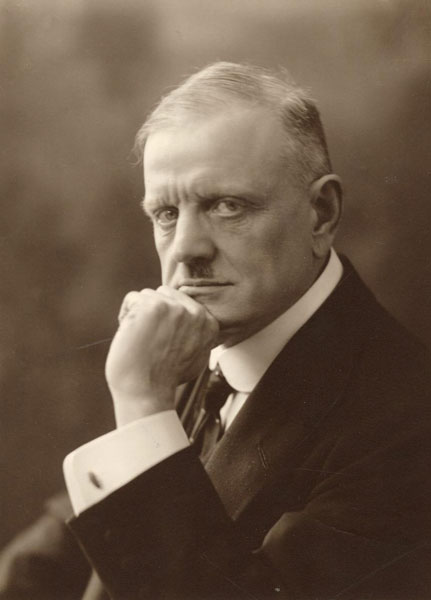
Sibelius in 1915
Photo: Atelier Apollo. Sibelius Museum Photo Archive / CC BY 4.0
Was Sibelius right to subject his Fifth Symphony to years of revision? The apparent answer is ‘yes’; the 1915 version comes across as motivically, harmonically and structurally far less confident than the 1919 one. When he revised the symphony Sibelius fused the first two movements – which in any case are thematically related – into a single entity. For anyone familiar with the final version, the original is like looking at an aerial photo of a famous city in which many of the most prominent landmarks have not yet been built. The serene horn call that begins the 1919 score – crucial both thematically and to establish the mood – is absent from the 1915 version. The transition passage that links what had once been the first and second movements is one of the crowning glories of the final version, and its absence in the 1915 score deprives the symphony’s topography of another of its most important features. And this is not the only climax that is missing: the end of the original second movement simply stops in its tracks, lacking the familiar (and spectacular) Più Presto coda.
The slow movement is slightly shorter in the 1915 version than in the final one. The thematic material is by and large similar, though the early score’s greater emphasis on unadorned string pizzicati and the relatively rudimentary character of some motifs give the impression of being a musical skeleton upon which the 1919 version added muscle and flesh. The 1915 finale is striking for its great length: 679 bars compared with 482 bars in 1919. The famous ‘swan hymn’ is jarringly interrupted by a motif from the first movement, now shockingly incongruous (trumpets, bar 198 ff.). The pillar-like chords that end the 1919 symphony are present in the 1915 version too, but are swathed in a string tremolo, like skyscrapers surrounded by scaffolding. For listeners used to the final version, the original can sound somewhat amorphous. It is of course no surprise that the final version of the symphony sounds tauter and more concentrated than the original: in other works, too, Sibelius had used the process of revision as an opportunity to refine and condense his musical material – examples being En saga, Lemminkäinen, Vårsång and the Violin Concerto.
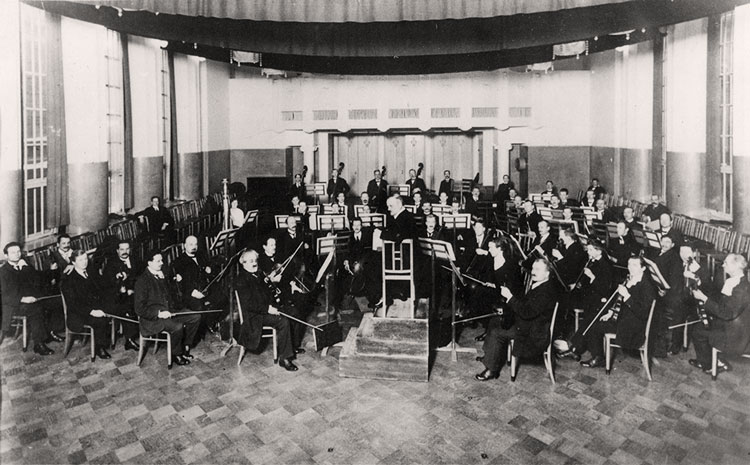
Sibelius conducting the Helsinki Philharmonic Orchestra
This photo is often said to have been taken during rehearsals in 1915 for the concert at which the Fifth Symphony was premiered, alongside the Serenades for violin and orchestra and The Oceanides. There is no harp in the symphony, and two would have been required for The Oceanides. This was the only programme that Sibelius conducted with this orchestra in 1915, but on 9 January 1916 – when he again played the original Fifth – the programme included The Bard, which requires a single harp.
Photo: Sibelius Museum Photo Archive / CC BY 4.0
Might we nowadays be so accustomed to the definitive version that any deviation from it simply sounds ‘wrong’? Reading the score of the 1915 Fifth Symphony, or listening to the work, is like viewing a much-loved painting through a prism, or like eating a deconstructed version of a classic restaurant dish. Many of the well-known features are there, but not in the form to which we are accustomed. Individual motifs are distorted, played by different instruments or heard in a different context.
The 1916 version of the symphony remains something of a mystery; not enough of it has survived to permit a full reconstruction. Timo Virtanen does, however, confirm that the 1916 first movement was in most respects identical to the final 1919 one. The 1916 finale was apparently even longer than in the 1915 score.
More than a work-in-progress (Sibelius did, after all, celebrate his fiftieth birthday with this work and conducted it at five subsequent concerts) but less than the consummate masterpiece that it would later become, the 1915 Fifth Symphony is essential study material for anyone who wants to understand the final version of the work fully – and yet it has never been published before. For this reason, the present volume in the JSW edition is of particular importance and value. The introductory essay by Timo Virtanen chronicles the work’s origins and early performance history; there are four facsimiles of sketch pages, five more showing pages from the orchestral parts and a lone score page that was reproduced in the magazine Tidning för musik in 1915. As always in JSW editions, there is a full list of critical commentaries and editorial remarks. The story of the Fifth Symphony will be continued when the 1919 version is released in a separate JSW volume (I/6b).
Andrew Barnett & Ian Maxwell
Review copy kindly supplied by Breitkopf & Härtel